
Blog
What Is an XVR Recorder and How It Fits Your CCTV Setup


Key Takeaways
An XVR recorder supports multiple camera signal formats in one unit, making it ideal for UK property owners upgrading CCTV systems without replacing existing coaxial cabling.
- An XVR recorder accepts analog, HD analog (HDTVI, HDCVI, AHD), and IP camera signals simultaneously, giving you a flexible upgrade path without a full system replacement.
- The hybrid capability of an XVR is most valuable in mixed or transitional setups where coaxial cabling already exists and new IP cameras are being added gradually.
- Before buying an XVR, verify which analog HD formats it supports, confirm ONVIF compliance for multi-brand IP camera integration, and match the channel count to your current and planned camera numbers.
- XVRs have realistic limitations including fixed IP channel allocations and bandwidth constraints, so a dedicated NVR remains the better choice for fully IP-based or large-scale uniform installations.
- Phasing upgrades over two to three years is a practical option with an XVR, since it retains your existing cameras and cabling investment while allowing you to add higher resolution IP cameras where needed.
If you have been researching CCTV upgrades and keep coming across the term XVR, you are not alone. Many property owners in Manchester, from terraced houses in Didsbury to commercial units in Trafford Park, reach a point where their existing system no longer meets their needs, yet they are reluctant to rip everything out and start from scratch. Understanding what an XVR recorder is can change how you approach that decision entirely, because it opens up a path that sits neatly between keeping legacy equipment and committing to a full IP overhaul.
This guide covers how XVR recorders work, how they compare to DVRs and NVRs, and what to check before buying one. Whether you are self-installing or working with a professional installer in Greater Manchester or beyond, knowing the terminology and the trade-offs will save you time, money, and frustration.
Table of Contents
What Is an XVR Recorder?
An XVR recorder is a hybrid video recorder that accepts multiple camera signal formats, including analog, HD-over-coax, and IP, all within a single unit. The X stands for extended or crossover, reflecting exactly what the device does.
Unlike a standard DVR, which handles analog or HD-over-coax cameras only, an XVR supports HD analog formats such as HDTVI, HDCVI, and AHD alongside IP camera streams simultaneously. This makes it a genuinely flexible piece of equipment rather than just a marketing label.
According to Valuates Reports, XVR SoCs integrate multiple processor cores, memory controllers, graphics processors, and network interfaces, all of which are what make that multi-format capability possible. It is also why an XVR can replace a DVR without requiring you to swap out every camera on site at the same time.
XVR vs DVR vs NVR: Understanding the Differences
Before choosing a recorder, it helps to understand what each type actually does.
A DVR (Digital Video Recorder) processes video at the recorder itself. Cameras send raw analog or HD-over-coax signals, and the DVR handles encoding locally. It is limited to one or two signal formats. An NVR (Network Video Recorder) works differently: the camera encodes and processes video before streaming it to the recorder for storage and remote viewing. NVRs are designed exclusively for IP cameras. An XVR (Extended Video Recorder) combines both functions. It can receive unprocessed coaxial signals and encode them locally, while simultaneously accepting pre-encoded IP streams from network cameras.
That dual capability is the core of what makes an XVR a true multi-format CCTV recorder. XVRs also support H.264 and H.265 compression, which keeps storage requirements manageable regardless of which camera types are connected.
| Recorder Type | Camera Compatibility | Video Processing | Best For |
|---|---|---|---|
| DVR | Analog and HD-over-coax only | At the recorder | Existing analog setups with no IP cameras |
| NVR | IP cameras only | At the camera | New installations or fully IP-based sites |
| XVR | Analog, HD-over-coax, and IP | Both at recorder and camera | Mixed or transitional systems with multiple signal types |
When a DVR Falls Short
Traditional DVRs were built for analog cameras. They struggle, or fail entirely, when you try to add a modern IP camera alongside existing coaxial cameras. If you want to cover a new area of your property without rewiring the whole site, a standard DVR cannot accommodate that without additional hardware workarounds.
When an NVR Is the Better Choice
For new installations or sites already running entirely on IP cameras, a dedicated NVR is often the cleaner, more straightforward option. IP cameras over Ethernet or PoE deliver higher resolution, support more advanced analytics, and scale easily across larger sites. If all your cameras are IP-based, the hybrid capability of an XVR adds no real value. The broader question of IP CCTV vs analog CCTV is worth exploring separately, because the right recorder follows directly from the camera types you commit to.
Why Manchester Properties Benefit From an XVR
The practical case for an XVR is strongest when your site already has coaxial cabling installed. This is particularly relevant across Greater Manchester, where a large share of residential streets and older commercial premises, including converted mill buildings in Ancoats, retail units in the Northern Quarter, and semi-detached homes across Salford and Stockport, were fitted with analog CCTV systems years ago. Replacing that infrastructure just to run IP cameras is expensive and disruptive, particularly where cables run through finished walls and ceilings.
An XVR lets you keep that existing cabling working while adding IP cameras in new locations where running a network cable is straightforward. The result is a gradual upgrade path rather than a forced full replacement.
Cost savings go beyond the cabling itself. XVRs support all major CCTV signal formats, including CVBS, TVI, CVI, AHD, and IP, whereas standard DVRs typically handle only one or two. For a small business owner managing a tight budget, the ability to phase upgrades across two or three years rather than replacing everything at once is a significant practical advantage.
XVR Compatibility: What to Check Before You Buy
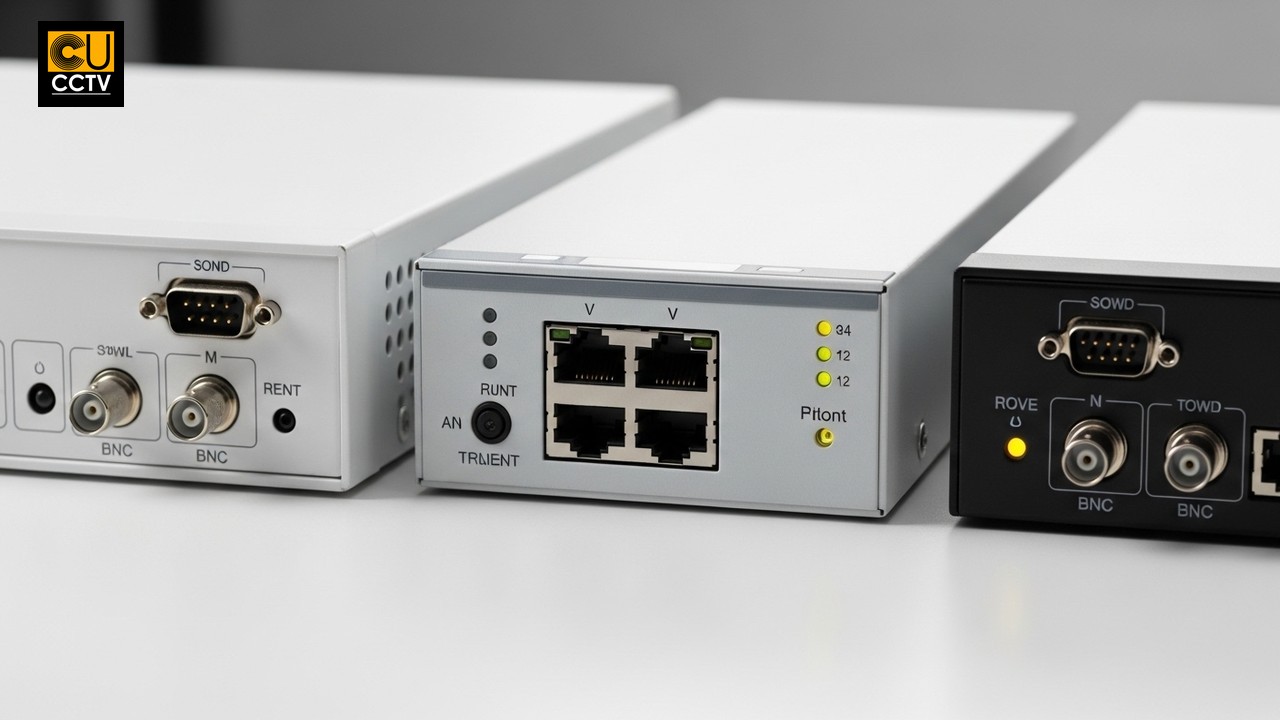
Not all XVR recorders accept the same signal types, so checking compatibility before purchasing is essential. The key things to verify are:
- Analog HD format support: HDCVI is associated with Dahua cameras, HDTVI with Hikvision, and AHD with a range of other manufacturers. A good XVR supports all three alongside standard CVBS. Check the specification sheet rather than assuming.
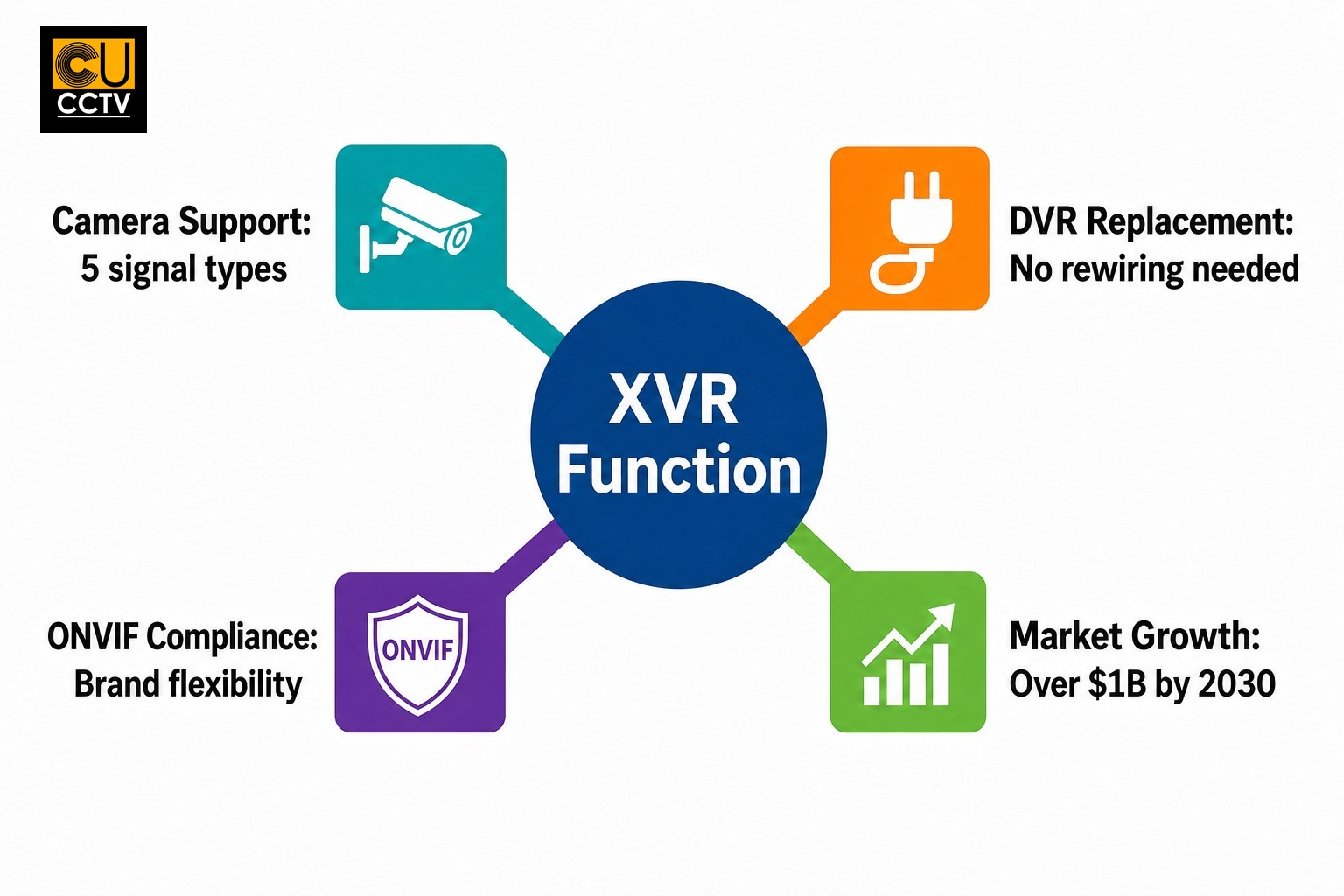
- Full format list: Look for confirmation that the unit supports at least five signal types: analog, HD-TVI, HD-CVI, AHD, and IP.
- Channel count and resolution: Confirm the recorder covers your current camera numbers and any you plan to add, and verify the resolution limit for both analog HD and IP inputs.
- ONVIF compliance: Essential if you are mixing cameras from different manufacturers. It provides a common protocol for IP camera integration and prevents brand lock-in.
Features Worth Comparing
Once basic compatibility is confirmed, the feature set is what separates a recorder that truly meets your needs from one that merely functions. Key things to compare include recording resolution, the reliability of the manufacturer’s remote viewing app, smart detection capabilities such as motion zones and line crossing alerts, and storage capacity calculated against your camera count, resolution settings, and required retention period.
Limitations of XVR Recorders
An XVR is not the right answer for every situation. Being clear on its limitations helps you avoid paying for hybrid capability you do not actually need.
- Fixed IP channel allocation: Most XVRs reserve only a fraction of their total channels for IP cameras, which can become a constraint if you plan to expand heavily into IP over time.
- Bandwidth demands: Running multiple high-resolution IP streams alongside HD-over-coax channels requires careful planning to avoid performance issues.
- Configuration complexity: The hybrid architecture can be more involved to set up than a simpler dedicated recorder.
If your site is already fully IP-based, a dedicated NVR is likely the more efficient and cost-effective choice. If your existing cameras are older standard-definition analog units with no upgrade planned, a basic DVR may serve you just as well at a lower price. The XVR earns its place specifically in mixed or transitional environments.
How to Choose the Right Recorder for Your Property
The decision comes down to a handful of practical questions: How many cameras do you currently have, and what signal types do they use? Is your existing cabling coaxial, Ethernet, or a mix of both? Are you planning to add cameras soon, and if so, what type? How large is the property, and how many days of footage do you need to store?
These questions frame the decision far more usefully than brand comparisons alone. The debate around Dahua NVR vs DVR, for instance, often comes down to exactly this kind of site assessment rather than a blanket recommendation.
This is where a knowledgeable supplier makes a real difference. CUCCTV’s team works with both trade professionals and hands-on property owners across Manchester and the wider UK, offering dedicated account manager support and a broad product range from Dahua and other leading brands. With stores in Manchester and Huddersfield and an extensive online catalogue, avoiding costly compatibility mistakes is much easier when you have the right people to ask.
The NVR and XVR SoCs market is forecast to grow from US$688 million to over US$1 billion by 2030, a sign that hybrid recording technology has established itself as a mainstream choice. Investing in the right recorder now, with guidance from a supplier who understands your setup, puts you in a strong position as that technology continues to develop.
If you are ready to choose the right recorder for your property or project, get in touch with the CUCCTV team. Whether you prefer to browse online, visit the Manchester or Huddersfield branch, or speak directly with an account manager, expert advice and genuine products are ready when you are.
Frequently Asked Questions About XVR Recorders
Can an XVR recorder replace my existing DVR without changing my cameras?
Yes, in most cases. An XVR accepts analog and HD-over-coax signals, the same formats most existing cameras use, so it can typically replace a DVR without requiring camera replacements. You reconnect your coaxial cables to the new unit and configure the settings from there.
How many IP cameras can I add to an XVR?
This varies by model. Most XVRs allocate a fixed number of channels for IP cameras, often between two and eight depending on total channel count. Always check the specification sheet for the maximum IP channel limit before purchasing, especially if you plan to expand your IP camera count over time.
Do I need ONVIF compliance if I only use one camera brand?
Not strictly, but it is still worth having. ONVIF compliance means that if you ever add cameras from a different manufacturer, the recorder will integrate them without compatibility issues. It also gives you more flexibility when replacing individual cameras over time.
Is an XVR recorder suitable for home use, or is it mainly for commercial properties?
XVRs are suitable for both. Homeowners with existing coaxial wiring and a mix of older and newer cameras benefit from the same hybrid flexibility as commercial users. Smaller channel-count models are widely available and appropriately priced for residential installations.
What is the difference between HDTVI, HDCVI, and AHD formats?
All three transmit high-definition video through standard coaxial cable, but they are associated with different manufacturers and are not cross-compatible. HDTVI is used by Hikvision, HDCVI by Dahua, and AHD by various other brands. A quality XVR supports all three, allowing cameras from different manufacturers to work on one recorder.
