
Blog
Video Door Station Features Worth Evaluating Before You Buy


Key Takeaways
A practical feature evaluation guide for trade installers covering camera quality, night vision, audio, weatherproofing, and compatibility before buying video door stations.
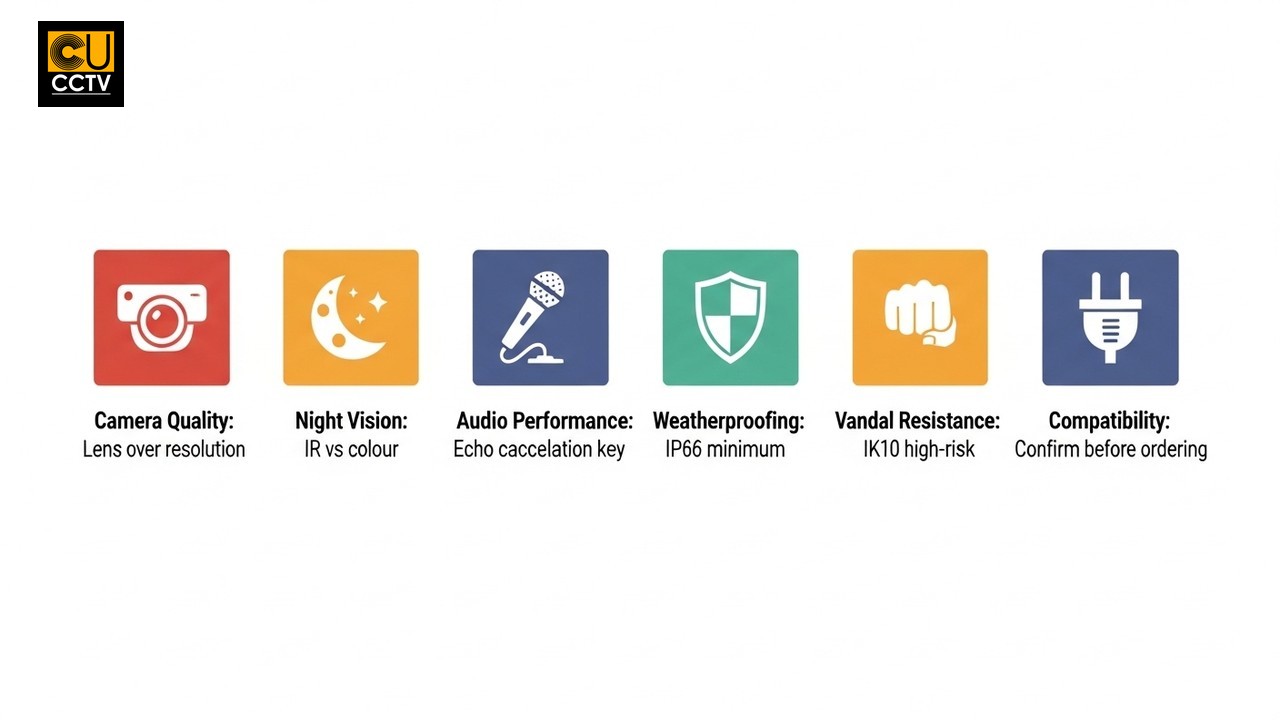
- Resolution alone does not determine camera performance — assess sensor size, wide dynamic range, and field of view against the specific geometry of each entry point to avoid post-installation complaints.
- Night vision capability must be matched to the actual approach depth of the site; IR range adequate for a residential front door will fall short on commercial loading bays or gated car parks.
- Door entry audio quality, including echo cancellation and noise suppression, is the feature end users notice most in daily use and the one most frequently underestimated during specification.
- For exposed or high-risk locations, IP66 or IP67 weatherproofing and an IK10 vandal-resistant housing should be treated as baseline requirements, not optional upgrades.
- Confirm protocol compatibility with your NVR, access control panel, and mobile platform before ordering — and verify power supply, cabling requirements, stock batch consistency, and firmware support with your supplier upfront.
Selecting the right video door station features before procurement is one of the most practical decisions a trade installer can make. Get it wrong across a batch of ten installations and you are fielding callbacks, managing warranty claims, and revisiting sites that should have been signed off. The market is expanding quickly, and according to Business Research Insights, the global video door entry systems market was valued at approximately USD 2.68 billion in 2023 and is projected to reach USD 7.08 billion by 2032. That growth reflects real demand from both residential and commercial clients, which means installers who understand the specification process carry a genuine competitive advantage. This guide is written for trade professionals who want a clear, practical framework for evaluating units before they commit stock or quote a project.
Whether you are specifying a single residential entry point or a multi-door commercial site, the fundamentals remain consistent. Camera quality, audio performance, weatherproofing, and system compatibility each deserve focused attention before any purchasing decision is made. This article sits within the broader context of a Dahua intercom comparison guide and is intended to give you the feature-level knowledge you need before moving into ecosystem and model selection. It does not cover IP intercom system basics, which is addressed separately, but assumes a working familiarity with how networked door entry systems operate.
Table of Contents
Why Feature Selection Matters for Trade Installers
The cost of a misspecified door station is not limited to the unit itself. Returning to site to swap out a camera with insufficient field of view, or explaining to an end client why their audio cuts out in wind, erodes both your margin and your reputation. Research from Consumer Intelligence found that only half of video doorbell owners use the technology regularly, compared to 85% of CCTV owners who actively check their systems. That gap in engagement is often the result of poor feature matching at installation, not a lack of interest from the end user. When the product does not suit the environment, it gets ignored.
For trade buyers, feature evaluation should be a standard part of the procurement process on every job, not a luxury reserved for premium projects. Understanding what each specification means in practice, rather than relying on headline marketing figures, lets you quote with confidence and install with fewer surprises. The sections below break down the most important features in the order they tend to cause problems when overlooked.
Video Door Station Camera Quality: What the Specs Actually Mean
Resolution is often the first figure installers check, but it is rarely the most important factor in real-world image quality. A 2MP camera with a well-engineered lens and proper wide dynamic range will outperform a 4MP unit with poor low-light handling in most entry point conditions. What matters in practice is how clearly the unit captures a visitor’s face at typical approach distances, under the lighting conditions present at that specific site.
Always assess resolution alongside sensor size, frame rate, and the presence of wide dynamic range or HDR processing before drawing conclusions from a spec sheet alone. Field of view is equally critical and often underspecified. Narrow corridors, recessed doorways, and close-range residential entry points behave very differently from open commercial forecourts or gated access points. Matching the lens to the physical geometry of the entry point is a straightforward step that prevents a significant number of post-installation complaints.
Wide-Angle vs Standard Lens: Which Entry Points Need Which?
Wide-angle lenses, typically those with a field of view above 120 degrees, suit open forecourts, wide pavements, and locations where multiple visitors may approach at once. They give the monitor viewer more spatial context and reduce blind spots on either side of the frame. However, at close range, particularly in narrow hallways or recessed residential porches, ultra-wide lenses introduce barrel distortion that can make faces appear stretched and difficult to identify. A standard lens in the 90 to 110 degree range will usually deliver cleaner, more usable images in those tighter environments.
When specifying, measure the typical approach distance and review sample footage from that range rather than relying on the advertised field of view figure alone.
| Lens Type | Field of View | Best Suited To | Potential Drawback |
|---|---|---|---|
| Wide-angle | Above 120° | Open forecourts, wide pavements, multi-visitor approaches | Barrel distortion at close range; faces may appear stretched |
| Standard | 90 to 110° | Narrow hallways, recessed porches, close-range residential entry | Reduced peripheral coverage on wider approaches |
Night Vision Performance: What to Check Before You Specify
Night vision is consistently listed among the most prioritised features by end users, and it is easy to see why. Most security-relevant events happen outside business hours, and a door station that delivers a clear daytime image but a washed-out or grainy feed after dark fails at precisely the moments that matter most.
Standard infrared illumination works well in fully dark conditions but produces monochrome images and can cause overexposure when a visitor stands very close to the camera. Colour night vision, which relies on supplemental warm-light LEDs, preserves colour detail but requires some ambient light to function well and may be visible to visitors approaching the door.
When reviewing specs, check the stated IR range against the actual depth of the approach path at the site. A unit rated to 10 metres is adequate for a residential front door but insufficient for a commercial loading bay or gated car park entrance. Where possible, request a demonstration from your supplier or review verified test footage rather than trusting manufacturer imagery, which is typically captured under controlled conditions. In Greater Manchester, ambient light from streetlamps, retail signage, and security floodlights varies considerably between a busy city-centre entrance and a quieter suburban street, and this can significantly affect which night vision approach performs best at any given location.
| Night Vision Type | Works In Complete Darkness | Image Colour | Visible to Visitor | Best Suited To |
|---|---|---|---|---|
| Infrared (IR) | Yes | Monochrome | Generally not visible | Fully dark environments; residential front doors |
| Colour night vision | No, requires some ambient light | Full colour | Warm-light LEDs may be visible | Locations with existing ambient light; city-centre entrances |
Door Entry Audio Quality: The Feature Installers Most Often Underestimate
Audio is the feature most frequently overlooked during specification and the one end users notice most acutely in daily use. A visitor who cannot be heard clearly, or who cannot hear the person responding from inside, will quickly lose confidence in the system regardless of how sharp the video image is.
Effective two-way communication requires a microphone sensitive enough to pick up speech at normal conversational volume from typical approach distances, combined with a speaker that remains clear and loud enough to be understood outdoors. Neither component should be evaluated in isolation.
Echo cancellation and noise suppression are particularly relevant when specifying units for busy commercial environments, roadside entrances, or sites near mechanical equipment. Without these features, feedback loops and background noise can make communication genuinely difficult even when both parties are trying to engage. This is especially worth considering on installations near Manchester’s busier arterial routes or at commercial sites in areas with high footfall and ambient noise. According to research highlighted by COMMEND, advanced audio features such as dynamic volume adjustment and full-spectrum voice bandwidth have a measurable impact on end-user satisfaction in demanding environments. Always test audio performance under realistic site conditions before finalising your product selection.
Weatherproof Ratings for Manchester Installations: IP and IK Standards Explained
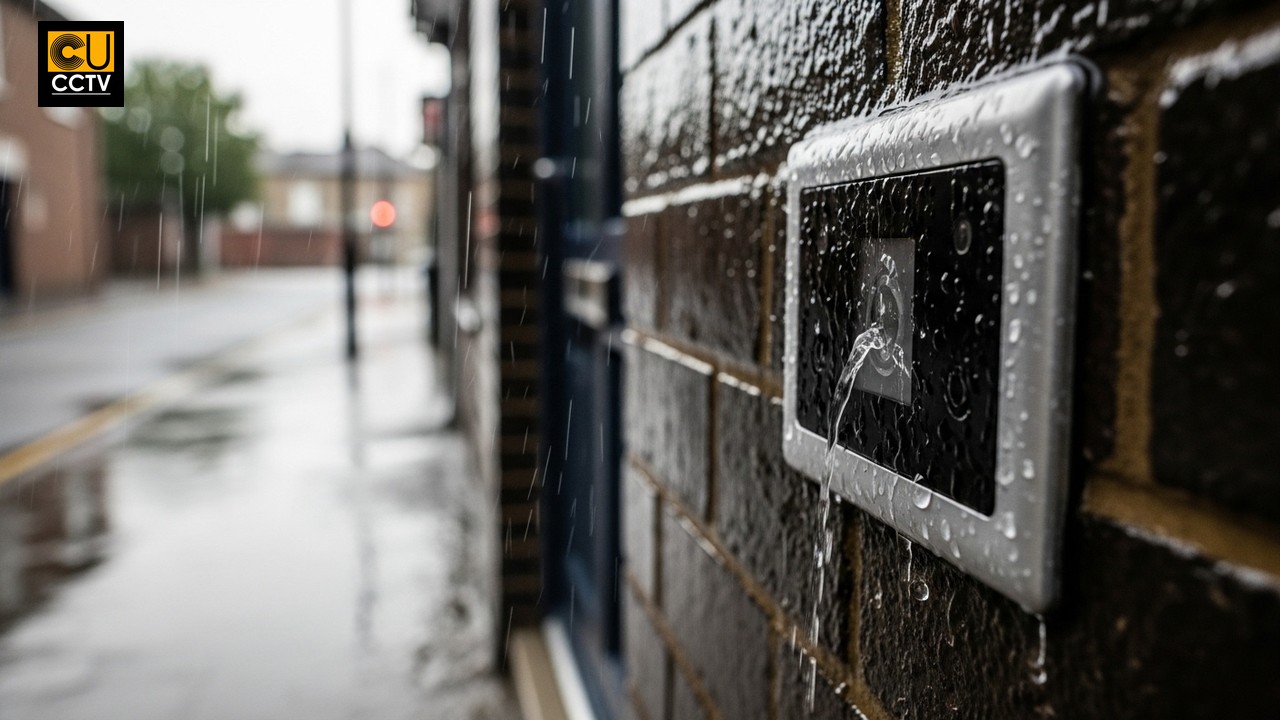
An IP rating tells you how well a door station enclosure is protected against dust ingress and water penetration. For outdoor installations across Greater Manchester, a minimum of IP65 is typically appropriate for sheltered residential porches and covered entrance canopies. IP66 and IP67 ratings offer stronger protection against sustained rain and temporary water immersion, making them better suited to exposed commercial facades, gate posts, and locations where the unit faces direct rainfall without overhead cover.
Given the consistently wet climate across the North West of England, it is worth defaulting to IP66 or above on any exposed installation rather than treating higher-rated units as a premium option. Temperature tolerance is a separate specification and equally important, particularly for sites across Greater Manchester and surrounding areas, where seasonal lows can affect electronics not rated for cold-weather operation. IP ratings and operating temperature range should always be assessed together.
It is also worth noting that an IP rating covers ingress protection only. It says nothing about mechanical durability, which is governed by a separate standard.
IK Ratings and Vandal Resistance: When Are They Essential?
The IK rating system measures resistance to mechanical impact. IK08 indicates resistance to 5 joules of impact, roughly a moderate blow from a blunt object. IK10, the highest classification, is rated to 20 joules.
For social housing communal entrances, car park access points, retail back-of-house areas, or any location identified as higher risk during the site survey, IK10 vandal-resistant housings should be treated as a baseline requirement, not an optional upgrade. This applies equally to installations in city-centre Manchester, inner-suburb developments, and outlying commercial estates. Specifying a standard housing in a vulnerable location will almost certainly result in physical damage within the first year of operation.
Compatibility and Integration: Practical Checks Before You Order
A door station that cannot communicate reliably with the rest of the installed system creates integration problems that are time-consuming and sometimes impossible to resolve without replacing hardware. Before committing to any unit, confirm protocol compatibility with the NVR, access control panel, and any mobile app platform already in use or planned for the project.
Dahua door stations, for example, integrate natively within the Dahua ecosystem, including NVR management, SmartPSS, and DMSS mobile access, which simplifies configuration and reduces the risk of compatibility issues on multi-device installations.
Confirm the following with your supplier before finalising any order:
- Power supply requirements: confirm whether the unit supports PoE, 12V DC, or 24V AC, and check that your planned cabling infrastructure matches.
- Cabling constraints: some door stations require dedicated two-wire or Cat5e runs, which affects installation cost and labour time on retrofit projects.
- Stock availability: for multi-unit projects, confirm that your supplier can fulfil the full quantity from a single batch to ensure consistent firmware versions and finish.
- Firmware and app compatibility: verify that the unit’s current firmware version is supported by the management platform your client will use.
Choosing a Supplier Who Supports the Specification Process
Buying tips are most useful when backed by a supplier who can apply them to your specific project. A distributor that lists products without offering pre-sales technical guidance leaves the burden of specification entirely with the installer, which increases the risk of errors on complex or unfamiliar site types. Trade installers benefit from working with a distributor who understands the products at a technical level and can advise on the right unit for a given environment before the order is placed, not after it has been delivered and installed.
CUCCTV operates as an authorised UK distributor for Dahua Technology and assigns a dedicated account manager to every registered trade account. When you are working through a specification for a mixed-use development with varied entry point requirements, whether that is a residential scheme in Salford, a commercial site in Trafford Park, or a multi-tenanted building in the city centre, you have a named contact who knows the product range, understands compatibility constraints, and can flag issues before they become site problems. With physical branches in Manchester and Huddersfield and a broad stock holding across door station models, CUCCTV is well placed to support both the specification process and the fulfilment needs of trade installers working across Greater Manchester and the wider North West. If you are evaluating units for an upcoming project or building out your standard specification list, get in touch with the team to discuss your requirements and find the right match for your sites.
Frequently Asked Questions About Video Door Station Features
What resolution should a video door station have for reliable face identification?
A 2MP resolution is generally sufficient for clear face identification at typical door entry distances, provided the camera has good wide dynamic range and a well-matched lens. Higher resolution alone does not guarantee better results if low-light handling or field of view is poorly engineered for the site.
Is IP65 weatherproofing enough for an outdoor door station in Manchester?
IP65 is adequate for sheltered positions such as covered porches or entrance canopies. For exposed outdoor locations in Greater Manchester’s wet climate, IP66 or IP67 is a more reliable baseline. Always assess IP rating alongside the unit’s stated operating temperature range before specifying.
When is an IK10 vandal-resistant rating necessary?
IK10 should be treated as a baseline for communal housing entrances, car park access points, and any location identified as higher risk during the site survey. Standard housings in vulnerable environments are likely to sustain physical damage within the first year and require early replacement.
What audio features matter most for a commercial door station installation?
Echo cancellation and noise suppression are the most practically important features for busy or noisy commercial environments. Without them, background noise and feedback loops make two-way communication unreliable even when the hardware is otherwise functional. Always test audio under realistic on-site conditions before committing to a unit.
How do I confirm that a video door station is compatible with an existing system?
Check protocol compatibility with your NVR, access control panel, and mobile app platform before ordering. Also verify power supply type, cabling requirements, and firmware version support. Confirm all of these directly with your supplier before the order is placed rather than after delivery.
What is the difference between IR night vision and colour night vision on a door station?
IR night vision works in complete darkness but produces monochrome images and can overexpose at very close range. Colour night vision uses warm-light LEDs to preserve colour detail but needs some ambient light and may be visible to approaching visitors. The best choice depends on the specific lighting conditions at each site.
