
Blog
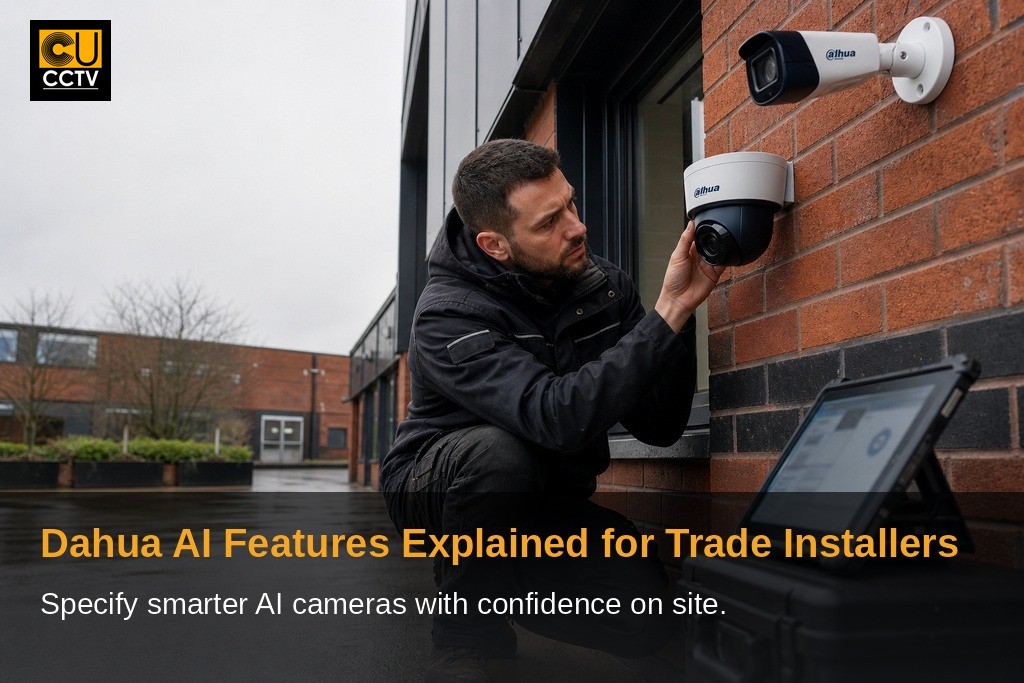
Dahua AI Features Explained for Trade Installers

Key Takeaways
A practical breakdown of Dahua AI features for trade installers covering perimeter protection, smart motion detection, face detection, and false alarm reduction across real installation scenarios.
- Dahua AI cameras use deep learning to classify humans and vehicles before triggering alerts, dramatically cutting false alarms compared to conventional pixel based motion detection and reducing post handover support calls.
- SMD Plus should be the baseline recommendation for residential installations where pets, foliage, and headlights cause constant nuisance triggers, as it filters non relevant targets before escalating any alert.
- Face detection and facial recognition are not the same thing; face detection confirms human presence at camera level without any database comparison, making it the proportionate and legally simpler choice for most commercial sites.
- Matching AI features to site conditions matters more than specifying the highest tier hardware; a well configured mid range Dahua camera with correctly defined zones will consistently outperform a premium camera with poorly set rules.
- Firmware versions, minimum face pixel counts, and edge versus recorder side processing all affect whether AI features perform reliably, so confirming compatibility at specification stage protects your reputation and avoids disputes after installation.
Understanding what Dahua’s AI technology actually does in the field is essential for any trade installer who wants to specify confidently and deliver systems that hold up under real-world conditions. This guide breaks down the core AI features found across Dahua’s camera and recorder range, explains how those capabilities translate to practical site protection, and helps you match the right tools to the right environments. Whether you are quoting a warehouse in Trafford Park, a residential estate in Didsbury, or a retail unit in the city centre, getting to grips with Dahua’s AI in plain terms will sharpen your proposals and reduce the risk of callbacks.
Dahua has embedded its AI technology across a wide range of application scenarios spanning retail, traffic, industrial, and urban environments. That shift from passive detection to active analysis is exactly what changes the conversation between installer and client.
Table of Contents
What Dahua AI Features Actually Do
Traditional motion detection works by flagging pixel-level changes in the image. A swaying tree, a passing car headlight, or a cat crossing the frame can all trigger the same alert as an intruder. For your clients, this means alert fatigue, ignored notifications, and a loss of confidence in the system.
Dahua’s AI processing changes the foundation of how cameras interpret movement. Deep learning algorithms primarily target people and vehicles, improving detection accuracy and significantly reducing false alarms compared to conventional motion detection. The system only escalates alerts that are relevant, reducing reactive monitoring and allowing site managers to act on notifications rather than dismiss them. For installers, it also means fewer support calls after handover.
Core Dahua AI Capabilities
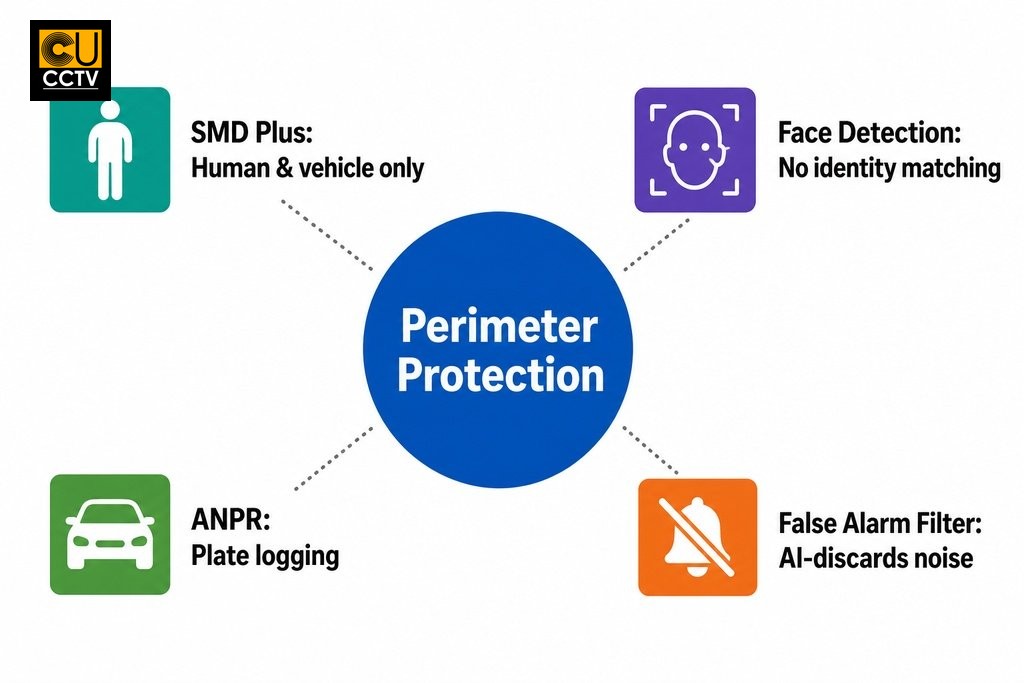
Dahua markets its AI feature set under the IVS (Intelligent Video System) label. The core capabilities span six main functions: perimeter protection via tripwire and intrusion zone detection; Smart Motion Detection Plus for human and vehicle classification; face detection to confirm human presence without facial recognition; people counting for retail and commercial footfall tracking; ANPR for vehicle access control; and AI-based false alarm filtering to discard non-relevant triggers.
Understanding which features operate at camera level and which require NVR or server-side processing is the first practical step when building a specification.
| AI Feature | Primary Function | Typical Processing Level | Best Suited For |
|---|---|---|---|
| Perimeter Protection (Tripwire & Intrusion Zone) | Alerts when targets cross or enter defined virtual boundaries | Camera or NVR | Warehouses, industrial yards, boundary fencing |
| SMD Plus (Smart Motion Detection Plus) | Classifies motion as human, vehicle, or animal before alerting | Camera level (compatible models) | Residential, retail exteriors, mixed environments |
| Face Detection | Confirms human face presence; no identity matching | Camera or NVR | Entrances, reception areas, retail counters |
| People Counting | Tracks footfall through defined zones | Camera or NVR | Retail units, commercial premises |
| ANPR | Reads and logs vehicle number plates | Camera or NVR | Car parks, access control, commercial estates |
| AI False Alarm Filtering | Discards triggers from lighting, foliage, rain, and small animals | Camera or NVR | All environments, especially residential |
Perimeter Protection: Tripwire and Intrusion Zones
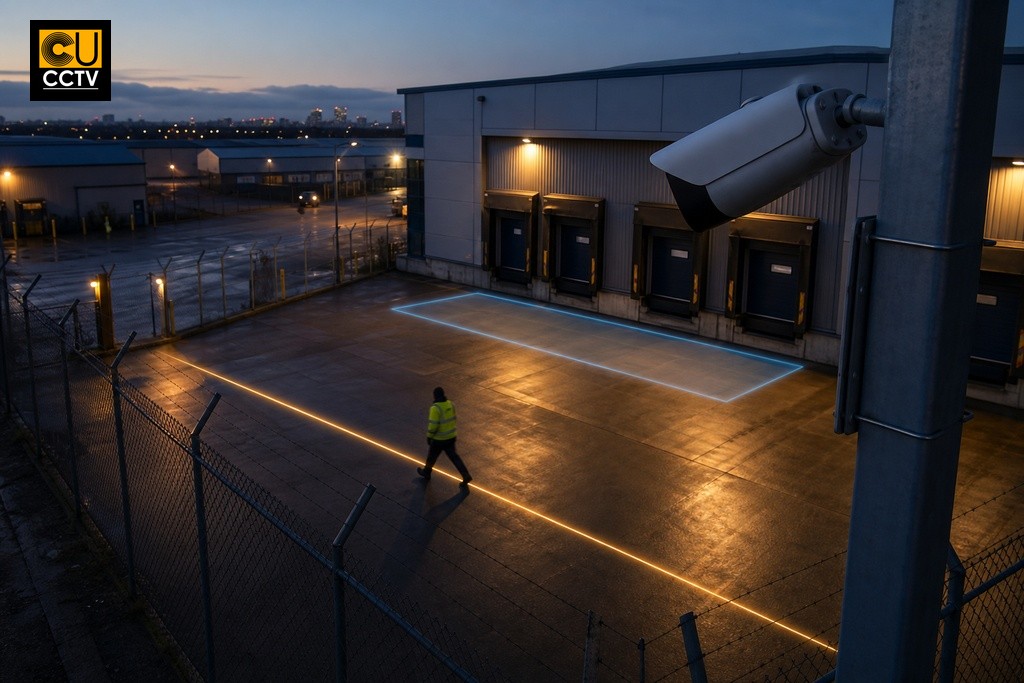
Perimeter protection works by drawing virtual boundaries within the camera’s field of view. A tripwire triggers an alert when a target crosses a defined line. An intrusion zone fires when a human or vehicle enters or lingers within a defined area.
These rules are configured at camera or NVR level and can include directional logic, meaning you can distinguish between someone entering a site and someone leaving it. This makes perimeter protection particularly effective for warehouses and industrial yards, car parks and commercial estates, and loading areas and boundary fencing. Because the AI classifies the target before applying the rule, this feature is considerably less prone to nuisance triggers than pixel-based detection.
Smart Motion Detection: How SMD Plus Works
SMD Plus (Smart Motion Detection Plus) uses deep learning to filter motion alarms triggered by non-relevant targets. It only alerts operators when a human or vehicle is confirmed in the scene.
This is the feature most relevant to residential installers, where environmental triggers such as pets, foliage, and vehicle headlights are a constant issue. The classification layer distinguishes between humans, vehicles, and animals, so alarm rules can be set to respond only to the targets that matter for that specific environment. For clients receiving frequent false alerts under existing systems, SMD Plus can make a meaningful difference to their confidence in CCTV.
Face Detection vs Facial Recognition
Face detection and facial recognition are not the same thing, and being precise with clients about this distinction matters. Face detection identifies that a human face is present in frame and can trigger a recording or alert. It does not compare that face against any database. Facial recognition, by contrast, requires a separate software layer and significant additional infrastructure.
Face detection is useful at entrances, reception areas, retail counters, and access points where confirming human presence adds event filtering without the legal and technical complexity of recognition systems. For most commercial installations, face detection is the appropriate and proportionate tool.
| Attribute | Face Detection | Facial Recognition |
|---|---|---|
| What it does | Confirms a human face is present in frame | Identifies or matches an individual against a database |
| Identity matching | No | Yes |
| Additional infrastructure required | Minimal; camera or NVR level | Yes; separate software layer and database |
| Legal complexity (UK) | Lower; generally proportionate for access points | Higher; requires careful UK GDPR and ICO compliance |
| Typical use case | Entrances, retail counters, reception areas | High-security access control, enterprise deployments |
| Suitable for most commercial installs | Yes | Depends on use case and legal basis |
False Alarm Reduction: The Most Persuasive Upgrade
AI filtering discards triggers caused by lighting changes, foliage movement, rain, and small animals by cross-referencing detected motion against learned target profiles. The result is a significant reduction in alerts that require human attention.
For residential proposals, this is often the single most persuasive feature. Homeowners and property managers are frequently accustomed to alarm systems they have learned to ignore. Positioning false alarm reduction as a core deliverable, rather than a technical specification, shifts the conversation from hardware to outcome, which is a stronger position in a competitive quote.
Matching Dahua AI Features to Manchester Installation Scenarios
Site conditions should drive feature selection rather than defaulting to the highest-specification option available. For retail units, people counting and face detection at entrances work well alongside SMD Plus on external cameras covering loading bays and rear access. Warehouses and industrial sites benefit most from perimeter protection with tripwire and intrusion zone rules across boundary fencing and loading doors, which is particularly relevant for larger industrial estates across Greater Manchester. Residential estates and driveways are well served by SMD Plus combined with ANPR where vehicle access is a concern. In car parks, higher-resolution cameras with edge AI processing tend to outperform NVR-side analysis where vehicle density creates overlapping detection zones.
A well-configured mid-range Dahua camera with appropriate AI rules will generally outperform a premium camera with poorly defined zones. Time spent on site before specifying is always worthwhile, particularly where clients have unusual layouts, mixed lighting, or complex access patterns.
Hardware Compatibility and System-Level Considerations
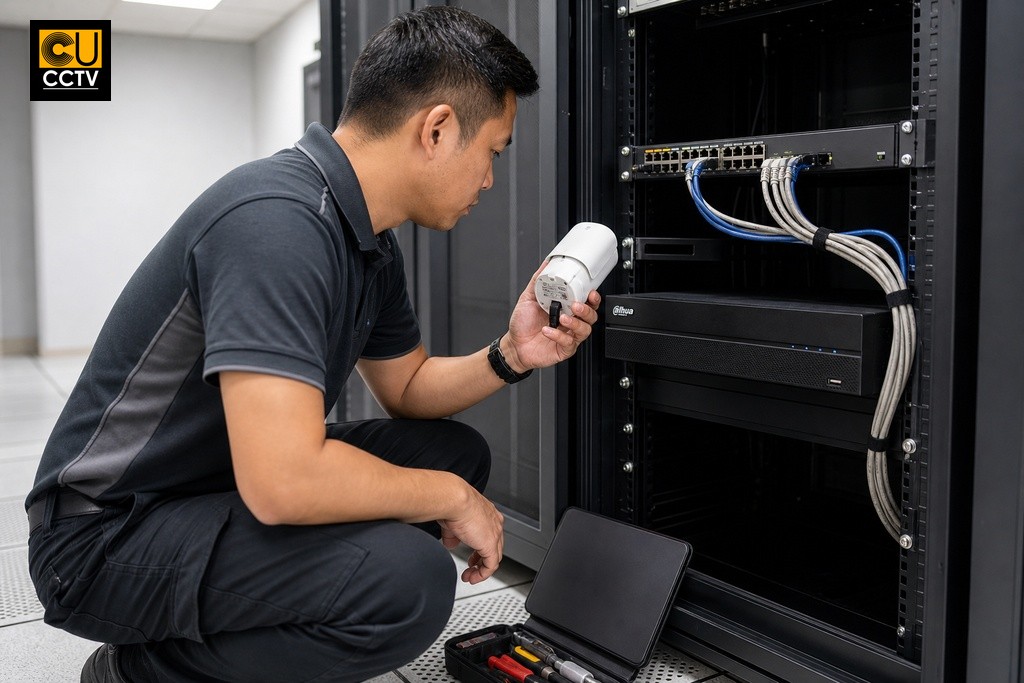
Dahua’s AI capabilities are distributed across cameras, NVRs, DVRs, and server-level hardware, with higher-specification units typically delivering greater detection accuracy. Edge AI processing handles classification directly at the camera, offering lower latency and reducing load on the recorder. NVR-side AI processing is available on compatible Dahua recorders and can apply intelligent rules to cameras without onboard AI chips, though with some constraints on simultaneous channel support.
Before specifying, confirm which features are handled at the camera and which require recorder support, as this affects both performance and cost. Firmware versions matter more than many installers expect: SMD Plus and advanced perimeter rules require specific firmware builds to function correctly. Resolution requirements apply too, since face detection needs a minimum face pixel count to operate reliably, meaning camera placement and lens selection directly affect whether the feature performs in practice.
When considering Dahua WizSense vs WizMind products, the distinction generally comes down to processing depth and the range of AI functions available natively on the device. WizMind supports more advanced analytics suited to commercial and enterprise deployments.
Limitations to Communicate Before You Specify
AI features have real boundaries worth communicating honestly to clients. Insufficient illumination reduces classification accuracy and increases false negative rates. Wide-angle lenses provide greater scene coverage but reduce the pixel density available for classification, limiting face detection and people counting at distance. Busy streets visible through fencing, or environments with significant infrared reflection, can degrade detection reliability.
In these cases, the right answer is usually additional cameras, better placement, or an upgrade to higher-tier hardware. Carefully adjusting Dahua motion detection settings can improve performance within those boundaries but will not overcome fundamental hardware or environmental limitations. Setting accurate expectations at the specification stage protects your reputation and reduces disputes after installation.
How CUCCTV Supports Manchester Installers Specifying Dahua AI Systems
CUCCTV is an authorised Dahua partner in the UK. Products supplied through our branches carry verified compatibility information and are backed by genuine manufacturer support. For trade installers working through the Dahua AI range, that authorisation gives you access to accurate product documentation, firmware guidance, and compatibility checks rather than relying on general online sources.
Our dedicated account managers work directly with trade customers to align product selection with project requirements, whether you are specifying a single retail unit or a multi-site commercial deployment across Greater Manchester and beyond. With our branch in Manchester, CUCCTV gives installers across the region the option to collect stock directly, discuss technical queries in person, and move quickly when project timelines are tight. Whether you are working in Salford, Stockport, Oldham, or anywhere across the North West, our team is well placed to support your Dahua AI specifications. Reach out to your account manager or visit your nearest branch to talk through your next project.
Frequently Asked Questions About Dahua AI Features
What is the difference between Dahua SMD Plus and standard motion detection?
Standard motion detection triggers on any pixel-level change in the frame, including foliage, headlights, and animals. SMD Plus uses deep learning to classify targets before raising an alert, so only confirmed humans or vehicles generate a notification. This reduces false alarms significantly and makes monitoring far more manageable for end clients.
Do Dahua AI features work on all cameras and recorders?
Not universally. Some AI functions, such as SMD Plus and perimeter protection, are available at camera level on compatible models, while others require a Dahua AI-capable NVR to process. Always check individual product datasheets and firmware requirements before specifying to confirm which features are supported on each device.
Is face detection legal to use in commercial CCTV installations in the UK?
Face detection, which confirms a human face is present without identifying the individual, is generally considered proportionate for access points and commercial entrances. It is distinct from facial recognition. UK installers should ensure systems comply with UK GDPR and ICO guidance, particularly regarding signage and data retention policies.
Can Dahua perimeter protection be used outdoors in all weather conditions?
Perimeter protection functions in most outdoor conditions, but heavy rain, dense fog, or extreme lighting changes can reduce classification accuracy. Selecting cameras with appropriate IP ratings and infrared or full-colour low-light capability helps maintain reliable performance across the varied weather conditions common in the North West.
What is the difference between Dahua WizSense and WizMind for AI features?
WizSense cameras are designed for SMD Plus and perimeter protection, making them well suited to residential and light commercial applications. WizMind cameras support a broader range of advanced analytics, including people counting, ANPR, and more sophisticated business intelligence functions, making them more appropriate for retail and enterprise deployments.
How do I ensure face detection works reliably on a Dahua camera?
Face detection requires the face to occupy a sufficient number of pixels in the frame. Camera placement, lens selection, and mounting height all influence this. Position cameras to capture faces at close to eye level where possible, and avoid wide-angle lenses at distances where the face size in frame becomes too small.
