
Blog
Dahua WizSense vs WizMind: Matching AI Tiers to Real Sites


Key Takeaways
This guide helps UK security installers choose between Dahua WizSense and WizMind by matching each AI camera tier to the right site type and client requirement.
- WizSense suits residential and small commercial sites where the priority is accurate human and vehicle detection with reduced false alarms, without the cost or complexity of advanced analytics.
- WizMind is justified for enterprise and high footfall environments requiring structured data outputs such as facial recognition, people counting, heat mapping, and ANPR.
- NVR compatibility must be confirmed at specification stage for both tiers, as pairing either camera range with a non AI recorder limits what the system can deliver.
- Lighting conditions and camera placement directly affect AI detection accuracy in both ranges, so setting realistic client expectations before installation protects the installer relationship.
- If a client brief is unclear or evolves between survey and specification, trade account holders at CUCCTV have access to a dedicated account manager who can confirm the right tier before procurement.
Choosing between Dahua’s two AI camera ranges is one of the more consequential specification decisions an installer makes on any project. Get it right and the system delivers precisely what the client needs. Overspecify and the client pays for analytics they will never use. Underspecify and the site ends up with gaps the brief was meant to close. This Dahua camera comparison guide focuses on exactly that decision: when WizSense is the right call, when WizMind is genuinely justified, and how to frame that conversation with clients before procurement begins.
Both ranges carry the Dahua AI label, yet they sit at very different points in the product architecture. Understanding what separates them at a functional and commercial level allows installers to specify with confidence rather than default to the higher tier whenever a client mentions AI.
Table of Contents
What Separates Dahua WizSense from WizMind?
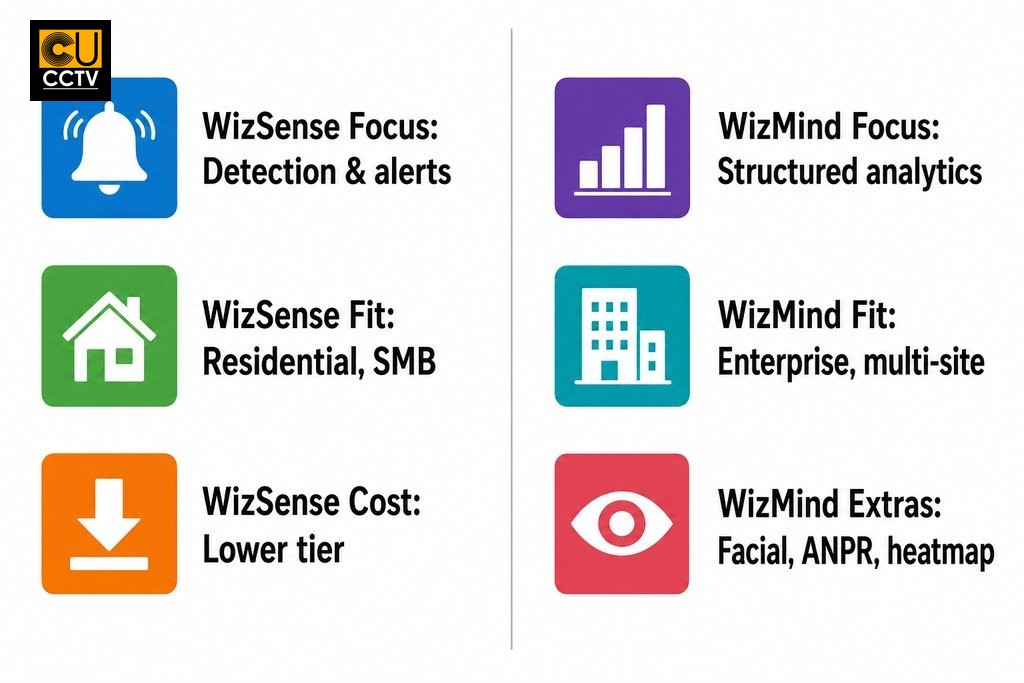
WizSense is Dahua’s detection-focused AI tier, designed for residential and small-to-medium business installations where reliable alarm filtering and human or vehicle classification are the main requirements. WizMind is the enterprise-grade tier, built for complex environments where scene intelligence needs to go well beyond basic detection.
In short: WizSense filters and alerts. WizMind analyses and reports.
Dahua developed these as distinct tiers because the demands of a residential perimeter and a high-footfall retail environment are genuinely different problems. A single product line attempting to serve both would either overengineer the simpler use case or underdeliver on the complex one.
The term “AI” in each case refers to meaningfully different processing approaches. WizSense uses independent AI chips and deep learning to deliver accurate, simplified analytics at camera level. WizMind implements end-to-end AI solutions where the intelligence runs deeper, covers more analytical categories, and produces structured data outputs that feed into broader operational workflows. The AI label alone is not a specification. The relevant question is always which analytical functions the site actually requires and whether the back-end infrastructure is in place to support them.
| Feature Area | WizSense | WizMind |
|---|---|---|
| Primary function | Detection and alert filtering | Structured scene analytics and reporting |
| AI processing approach | Independent AI chip, deep learning at camera level | End-to-end AI, deeper multi-category intelligence |
| Target installation type | Residential and small-to-medium commercial | Enterprise and complex multi-site environments |
| False alarm filtering | Yes, SMD Plus technology | Yes, plus advanced scene classification |
| Facial recognition | No | Yes, Facial Recognition 2.0 |
| ANPR / vehicle metadata | No | Yes |
| People counting / heat mapping | No | Yes |
| Back-end infrastructure demand | Standard Dahua NVR range | Compatible NVRs, storage planning, possible licensing |
| Relative cost tier | Lower | Higher |
WizSense: Capabilities and Best-Fit Installations
WizSense cameras are built around SMD Plus technology, which uses deep learning to filter false alarm triggers caused by animals, rustling leaves, moving branches, and similar non-human motion. The result is a detection workflow focused on people and vehicles, reducing nuisance alerts without requiring significant back-end configuration.
For many residential and small commercial sites, this is precisely what clients want: a system that responds when something meaningful enters the scene and stays quiet when it does not. Alongside SMD Plus, WizSense camera features include perimeter protection, human and vehicle classification, and integration with Dahua NVRs and mobile applications.
Where WizSense Performs Best
WizSense delivers strong value across the following environments:
- Residential properties with garden or driveway coverage
- Small retail units managing after-hours security
- Light industrial perimeters with straightforward coverage needs
- Small office environments with uncomplicated camera layouts
These are settings where specifying WizMind would add cost without adding any meaningful operational benefit. Across Greater Manchester, from suburban residential streets to smaller commercial units in areas such as Salford, Stockport, and Oldham, WizSense represents the most practical and cost-effective starting point for the majority of installations.
Budget and Hardware Compatibility
WizSense integrates across the standard Dahua NVR range, which simplifies procurement for installers managing multiple cost-sensitive jobs. The choice between tiers often becomes most commercially significant at the NVR level. The recorder’s AI capability determines how much of either platform’s analytics can be fully utilised. Pairing a WizSense camera with a non-AI NVR limits what the system can deliver, so compatibility needs to be confirmed at the point of specification rather than after installation. For trade accounts managing volume across varied project types, WizSense’s pricing and broad compatibility make it the more practical baseline tier.
WizMind: Capabilities and Advanced Site Demands
WizMind is designed for environments where basic detection is not enough. Its capabilities extend well beyond alarm filtering and into structured scene intelligence. Core WizMind features include:
- Facial Recognition 2.0, including search by entry frequency and known staff exclusion
- Automatic Number Plate Recognition (ANPR) and vehicle metadata collection
- People counting with customer traffic statistics by age and gender
- Heat mapping, crowd density monitoring, and dwell time analysis
- Privacy protection with mosaic masking for GDPR-conscious environments
The processing demands are correspondingly higher, and the back-end infrastructure, including compatible NVRs, storage capacity, and in some cases licensing or platform access, needs to be planned from the outset. WizMind is better suited to specified installations with defined analytics requirements than to general-purpose rollouts.
Where WizMind Adds Real Value
WizMind justifies its positioning in environments where the client needs more than security coverage:
- Multi-site retail operations tracking customer flow and footfall
- Transport hubs managing crowd density
- Government or public sector facilities requiring forensic-grade video review
- Industrial sites with vehicle access control requirements
The deeper the client’s requirement for structured data outputs and operational reporting, the more clearly WizMind earns its place in the specification. In Manchester city centre and across larger commercial districts such as Trafford Park, MediaCityUK, and Spinningfields, the combination of high footfall, multi-tenancy buildings, and complex access requirements makes WizMind a natural fit for many larger-scale deployments.
Reporting Capabilities and Client Expectations
WizMind is built for clients who expect data as well as footage. It supports audit trails, occupancy metrics, dwell time analysis, and integration pathways that feed surveillance data into broader operational platforms. For a retail client benchmarking footfall against sales performance, or a facilities manager tracking space utilisation, these outputs are directly useful. It is worth confirming which analytics outputs will actually be used in practice, as unused capability increases cost and system complexity without adding operational value.
How to Choose the Right Tier for a Given Site
The most useful way to approach this decision is through a structured set of site and client criteria. Use the following questions to guide the specification:
- What is the primary objective? Detection and alerts point to WizSense. Structured analytics and reporting point to WizMind.
- What is the site scale and complexity? A small retail unit needing customer counting is a better WizMind candidate than a large warehouse with a purely perimeter-based brief.
- What back-end infrastructure is in place? WizMind requires compatible NVRs, adequate storage, and in some cases licensing. Confirm this before specifying.
- What is the budget ceiling? WizSense is the more accessible tier. WizMind carries a higher cost that needs to be justified by genuine analytical requirements.
If the client’s requirements may expand over time, confirm the upgrade path between tiers at the initial consultation stage. For a deeper look at what each tier offers analytically, the Dahua AI features explained resource covers the underlying capabilities in practical terms.
Common Specification Mistakes to Avoid
Two mismatches come up regularly in practice. The first is WizMind specified where WizSense would perform equally well, usually because the installer or client defaults to the higher tier without examining whether the advanced analytics will be used. The second is WizSense specified where the site genuinely needs more, often because the analytics requirement only becomes apparent once the client starts asking what the system can do beyond alerting. Running through the client brief in detail before procurement avoids both scenarios.
AI Performance Limitations Installers Should Account For
AI analytics in both ranges perform within defined parameters. These are worth understanding before installation:
- Lighting conditions directly affect detection accuracy. Poorly lit scenes, strong backlight, or rapid light transitions can reduce reliability in both WizSense classification and WizMind facial recognition.
- Camera placement affects scene complexity. A camera covering too wide an area or positioned at an angle that obscures key identifiers will limit what the AI can reliably interpret.
- System expectations need to be set accurately with clients, particularly around Dahua motion detection settings and how they interact with scene conditions.
Neither range operates as an infallible system. WizSense will significantly reduce false alarms but will not eliminate them in every environment. WizMind’s facial recognition and ANPR functions depend on camera placement, image quality, and lighting meeting the conditions required for reliable operation. Setting accurate expectations at the start of a project protects the installer’s relationship with the client and prevents misunderstandings once the system is live.
How CUCCTV Supports AI Camera Specification Across Manchester and the North of England
As an authorised Dahua partner in the UK, CUCCTV stocks both WizSense and WizMind across the full range of camera types from its Manchester branch. The team is equipped to support specification decisions before procurement rather than after. Trade account holders are assigned a dedicated account manager who can work through a project brief, confirm NVR compatibility, and identify the right tier for the site in question. This is particularly useful on projects where the analytics requirement is not immediately clear-cut, or where the client’s brief has evolved between survey and specification.
Trade pricing is available across both ranges. Whether the project is a straightforward residential install in Didsbury or Chorlton, or a multi-camera commercial deployment in the city centre with reporting requirements, the support available through a CUCCTV trade account is designed to sit alongside the project from initial specification through to procurement. Installers based in Manchester and across the North of England also have the option of visiting the Manchester branch directly to discuss projects in person and view the product range.
Specifying with Confidence Across Different Project Types
WizSense is the right starting point for the majority of residential and small commercial projects where accurate detection, reduced false alarms, and system reliability are the brief. WizMind belongs on projects where the client has a genuine requirement for structured analytics, reporting outputs, or advanced identification functions, and where the infrastructure to support those functions is either already in place or being built into the specification.
Neither tier is universally superior. The right choice depends entirely on matching the platform’s capabilities to what the site and the client actually need. If a client’s requirements shift after the initial survey, or if the scope of a site changes during the project, it is always worth revisiting the specification rather than defaulting to the original tier. The cost of respecifying at planning stage is far lower than replacing hardware after installation. For any project across Manchester or the wider North of England where the right tier is not immediately clear, contact the CUCCTV trade team for guidance from your dedicated account manager.
Frequently Asked Questions
What is the main difference between Dahua WizSense and WizMind?
WizSense is a detection-focused tier that filters false alarms and classifies humans and vehicles, making it well suited to residential and small commercial sites. WizMind is an enterprise tier with deeper analytics including facial recognition, ANPR, people counting, and heat mapping, suited to sites where structured data outputs are required alongside security coverage.
Can WizSense cameras work with any Dahua NVR?
WizSense cameras are compatible across the standard Dahua NVR range, but the recorder’s AI capability determines which analytics are fully available. Pairing a WizSense camera with a non-AI NVR will limit what the system can deliver. Always confirm NVR compatibility at the specification stage to avoid limitations post-installation.
Is WizMind worth the additional cost for smaller sites?
Generally, no. WizMind’s advanced analytics, such as facial recognition, footfall reporting, and crowd density monitoring, add real value only where the client will actively use those outputs. For most residential or small commercial sites, WizSense delivers everything required at a lower cost and with less back-end complexity.
Does WizMind require additional licensing or software?
Some WizMind features, particularly those integrating with wider building management or operational platforms, may require compatible software, licensing, or platform access. Confirm these requirements with your supplier before specification to ensure the full analytics capability is accessible once the system is live.
How does lighting affect WizSense and WizMind performance?
Lighting conditions directly affect both tiers. Poor illumination, strong backlight, or rapid light changes can reduce classification accuracy in WizSense and impair facial recognition or ANPR reliability in WizMind. Camera placement and scene lighting should be assessed at survey stage to ensure consistent performance under real-world conditions.
Can CUCCTV help me choose between WizSense and WizMind for a specific project?
Yes. CUCCTV’s trade team in Manchester provides pre-procurement specification support, including NVR compatibility checks and tier recommendations based on the project brief. Trade account holders have access to a dedicated account manager, and installers can visit the Manchester branch in person to discuss requirements and view the product range.
