
Blog
Dahua Warranty Considerations Every Buyer Should Know

Key Takeaways
Understanding Dahua warranty considerations before buying helps UK business owners avoid costly gaps in coverage and ensures long-term security system reliability.
- Dahua offers a five year warranty on qualifying project based products shipped from January 2022, covering IP cameras, HDCVI cameras, NVRs, DVRs, and PTZ devices at no extra cost.
- Warranty cover is limited to repair or replacement of defective products and does not include data loss, consequential damages, or recovery costs, so businesses must back up data before submitting devices for service.
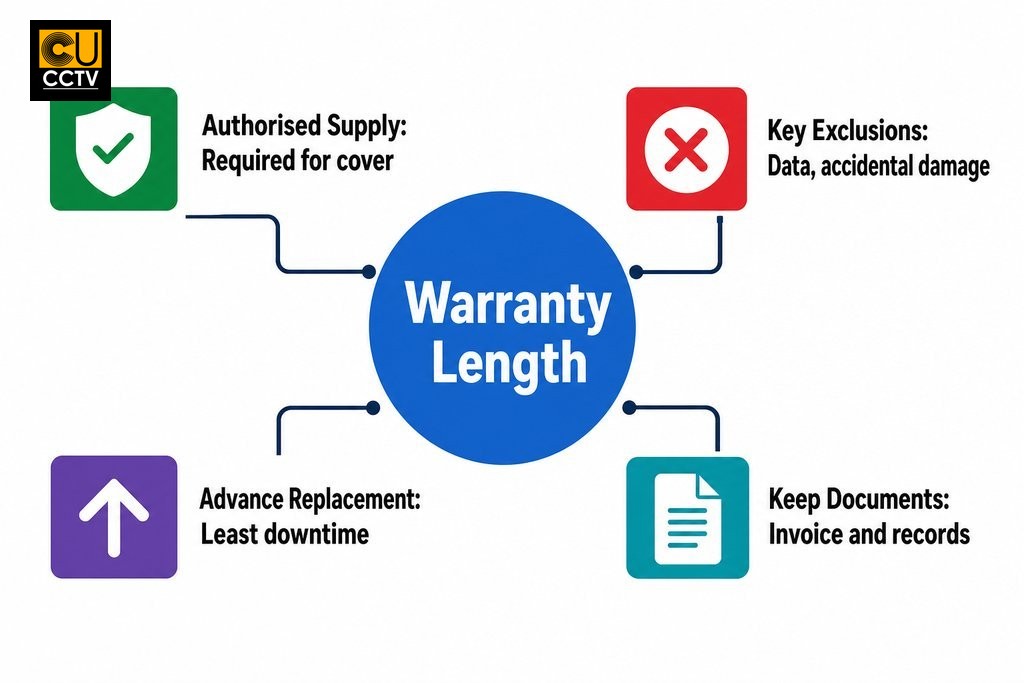
- Purchasing through an authorised UK distributor is essential; grey market products will not carry valid manufacturer warranty cover, making both warranty documentation and any service agreements ineffective.
- A practical CCTV warranty checklist should confirm warranty duration, supplier authorisation status, required documentation, claim procedures, and any product registration deadlines before purchase.
- Service level agreements and maintenance contracts complement manufacturer warranties by providing faster response times, scheduled health checks, and agreed escalation procedures that standard warranty terms do not cover.
When investing in a CCTV system for a business premises, the product specification is only part of the decision. The warranty behind that product matters just as much, particularly when your security infrastructure is expected to perform reliably over many years. Whether you are outfitting a warehouse in Trafford Park, a retail unit in the Northern Quarter, or a multi-site commercial operation across Greater Manchester, knowing exactly what you are covered for is as important as the cameras themselves.
This guide is written for business owners and facility managers who want clear, practical answers rather than technical jargon. It covers what Dahua’s warranty actually includes, the conditions that affect claims, what to look for in a supplier, and how to protect your investment from day one.
Table of Contents
Why Warranty Terms Matter More Than Most Buyers Realise
Warranty terms are often treated as a formality, something to glance at before signing off on a purchase. For businesses making a significant outlay on surveillance infrastructure, that approach carries real risk. A warranty is only as useful as your ability to understand it and act on it when something goes wrong. If the terms are unclear, the supplier relationship is weak, or the product was not purchased through an authorised channel, you may find yourself with no meaningful cover at all.
The financial consequences of poor warranty management can be significant at every level of the supply chain. Research cited in Continuum’s work with DSG illustrates how write-offs in returns and warranty processes can require many multiples in new sales just to recover the loss. For a business owner relying on a security system to protect staff and assets, an unresolved warranty claim is not just inconvenient. It can leave premises unprotected and generate unexpected replacement costs.
What Dahua’s Warranty Actually Covers
According to the Dahua Technology official press release, selected project-based products shipped from 1 January 2022 onwards are covered by an upgraded five-year warranty, free of charge, with no additional payment required from the customer or dealer. Qualifying product categories include IP cameras, HDCVI cameras, storage devices (NVRs and DVRs), and PTZ devices.
The warranty period begins from the date of invoicing to the end customer. Where no purchase receipt is available, it starts 60 days from the date of shipment.
It is equally important to understand what the warranty does not cover. As Dahua’s official policy states: “Dahua’s sole responsibility under Dahua’s warranty is limited to repairing or replacing the defective products returned by Customer if the same is still within the product warranty period.” The warranty does not extend to data recovery, data loss, or any consequential losses. Customers are responsible for backing up and erasing all data from devices before submitting them for service.
| Product Category | Covered by Extended Warranty | Warranty Duration | Notable Exclusions |
|---|---|---|---|
| IP Cameras | Yes (qualifying project-based products) | Five years from invoice date | Data loss, accidental damage, consequential losses |
| HDCVI Cameras | Yes (qualifying project-based products) | Five years from invoice date | Data loss, accidental damage, consequential losses |
| NVRs and DVRs | Yes (qualifying project-based products) | Five years from invoice date | Data loss, data recovery, consequential losses |
| PTZ Devices | Yes (qualifying project-based products) | Five years from invoice date | Data loss, accidental damage, consequential losses |
Conditions That Could Affect Your Warranty Claim
Even a strong warranty can be undermined by circumstances outside its stated conditions. The following factors commonly determine whether a claim is accepted:
- Authorised supply chain: Products must be purchased through an authorised UK distributor. Grey-market or unverified products will not carry valid manufacturer warranty cover.
- Professional installation: Correct installation by a qualified engineer is typically required.
- Dead on Arrival (DOA) time limit: Where Dahua is the responsible party, replacement must occur within 90 days from the ex-factory date.
- Freight damage reporting: Damage must be reported promptly with supporting evidence. Delayed reporting is a common reason for rejected claims.
- Proper handling and storage: Products must have been correctly handled and stored from the point of delivery.
Purchasing through an authorised UK channel is the most reliable way to ensure your warranty remains intact from the outset.
Questions to Ask Before You Buy: CCTV Warranty Checklist
Before finalising any CCTV purchase, work through these questions to compare suppliers on equal terms and avoid costly surprises later.
- What is the exact warranty duration for the specific product models you are buying, and does it apply in the UK?
- Is the supplier an authorised Dahua distributor, and can they provide evidence of that status?
- What documentation will you need to retain to support a future claim, including proof of purchase and installation records?
- Does the warranty cover return to base, advance replacement, or on-site support, and what are the turnaround times?
- What is explicitly excluded from coverage, such as data loss, accidental damage, or improper installation?
Camera Warranty Terms Explained in Plain Language
Three terms appear regularly in UK commercial CCTV purchases and are worth understanding clearly before you commit.
Return to base means you send the faulty product back to the supplier or manufacturer for assessment and repair. Advance replacement means a replacement unit is dispatched before the faulty one is returned, minimising operational downtime. On-site support means an engineer visits the premises to assess or resolve the issue directly.
For most commercial buyers in Greater Manchester and across the North West, advance replacement is the most operationally practical option, as it keeps systems running while the fault is investigated. According to the Dahua Technology Warranty Policy, Dahua has established 57 overseas subsidiaries and representative offices, along with more than 150 authorised customer service stations worldwide. That scale of infrastructure gives UK buyers reasonable confidence that support channels exist beyond a single local contact, though the quality of your experience will still depend on the authorised partner you work with directly.
| Service Type | How It Works | Impact on Downtime | Best Suited For |
|---|---|---|---|
| Return to Base | Faulty unit sent to supplier or manufacturer before replacement is issued | Higher — system offline until replacement arrives | Lower-priority or non-critical installations |
| Advance Replacement | Replacement unit dispatched before faulty unit is returned | Lower — system kept running while fault is investigated | Commercial premises requiring continuous coverage |
| On-Site Support | Engineer visits premises to assess or resolve the issue directly | Lowest — issue addressed without removing equipment | Complex multi-camera or multi-site installations |
What to Look for in a Supplier’s After-Sales Support
A manufacturer’s warranty is a policy document. The supplier determines how smoothly a claim is processed in practice. When evaluating after-sales support, prioritise suppliers who offer clear escalation paths and a dedicated support contact, the ability to act as an intermediary with the manufacturer, transparent turnaround times for replacements or repairs, and verifiable authorised distributor status.
CUCCTV operates as an authorised Dahua partner with a store in Manchester. Trade customers have access to genuine products covered under Dahua’s full warranty terms, along with a dedicated account manager for each registered trade account. For facility managers overseeing multi-camera installations across sites in Manchester, Salford, Stockport, or further afield across the North West, having a named contact who understands both the products and the claims process makes a practical difference when rapid resolution matters.
When a Manufacturer’s Warranty Is Not Enough
A manufacturer’s warranty, however comprehensive, has defined limits. It covers defective products within a set period under specified conditions. It does not address equipment wear over time, accidental damage, system configuration issues, or the cost of extended downtime while a replacement is being processed.
For businesses where continuous security coverage is a compliance or operational requirement, relying solely on warranty documentation is unlikely to be sufficient. Service-level agreements and maintenance contracts can fill the gaps, providing faster response guarantees, scheduled health checks, and agreed escalation procedures.
Before signing any maintenance contract, verify that the products in your system were purchased through an authorised supply chain. Grey-market products may appear identical but will not carry valid manufacturer warranty cover, making both your warranty documentation and any associated service agreement ineffective. Proof of authorised supply is not a bureaucratic detail. It is a commercial safeguard.
How to Buy Dahua Products With Confidence in the UK
Informed purchasing is the most reliable way to protect a long-term security investment. The steps are straightforward but require active attention before a problem arises.
- Verify authorised distributor status: A reputable distributor will confirm this readily. You should not need to take it on trust.
- Retain all documentation: Keep invoices, delivery records, and product registration confirmations from the point of purchase.
- Understand registration requirements: The models and categories covered by Dahua’s extended warranty can vary by region, so check what applies to your specific product lines.
- Evaluate warranty terms alongside other factors: Total cost of ownership, supplier support quality, and system compatibility all deserve equal attention.
Buyers comparing brands will naturally encounter the Dahua vs Hikvision comparison and may also be reviewing a Dahua camera app comparison as part of their wider system assessment. Warranty terms are one important layer of the purchasing decision, and they are best evaluated as part of the full picture. As Dahua’s own statement notes: “The extended warranty represents another Dahua initiative to offer the best benefits in the video surveillance industry to help its dealers stay competitive.” That commitment is most fully realised when buyers purchase through the right channels and understand exactly what they are entitled to.
At CUCCTV, our team is ready to walk you through the warranty terms applicable to any product in the Dahua range, confirm authorised supply chain status, and help you build a purchasing decision you can rely on for years to come. Reach out to speak with a dedicated account manager at our Manchester or Huddersfield store, or contact us through our online platform to get straightforward answers to your warranty questions before you buy.
Frequently Asked Questions About Dahua Warranty
How long is the Dahua warranty for UK buyers?
Selected Dahua project-based products shipped from 1 January 2022 onwards carry a five-year warranty at no additional cost. The period starts from the invoice date to the end customer, or 60 days from shipment if no proof of purchase is available. Qualifying categories include IP cameras, HDCVI cameras, NVRs, DVRs, and PTZ devices.
Does buying from an unauthorised supplier affect my Dahua warranty?
Yes. Products purchased outside Dahua’s authorised supply chain, including grey-market sources, will not carry valid manufacturer warranty cover. Even if the product appears identical, the warranty will not be honoured. Always confirm authorised distributor status before purchasing.
What does Dahua’s warranty not cover?
Dahua’s warranty does not cover data loss, data recovery, consequential losses, accidental damage, or equipment wear over time. It is limited to repairing or replacing defective units within the warranty period under the stated conditions. Customers must back up and erase all data before returning a device for service.
What is the difference between return to base and advance replacement under a CCTV warranty?
Return to base requires you to send the faulty unit to the supplier or manufacturer before any replacement is issued. Advance replacement means a new unit is dispatched to you first, reducing system downtime. For commercial premises where uninterrupted security coverage matters, advance replacement is generally the more practical option.
What should I retain after purchasing a Dahua CCTV system to protect my warranty?
Keep your original invoice, delivery records, product registration confirmation, and installation documentation. These are typically required to support a warranty claim. Missing proof of purchase can push the warranty start date back to 60 days after shipment, and gaps in documentation may lead to rejected claims.
Can a service-level agreement replace a manufacturer’s warranty?
No. They serve different purposes. A manufacturer’s warranty covers product defects within defined conditions. A service-level agreement provides response time guarantees, scheduled maintenance, and agreed escalation procedures. For businesses with continuous security requirements, both are advisable rather than treating one as a substitute for the other.
